Wednesday, 27 April 2011

Easter Escapades

We’ve been a little patchy with our updates of late, mainly as nothing much has been happening. Nets have gone up, birds haven’t necessarily gone in. Easter, however is a time for celebration – after all it brings a four day weekend which in turn means ringing, ringing and more ringing.

Our tale starts on Thursday with a visit to our favourite wetlands reserve here in Cardiff, where several species of warbler, including stripy and non-stripy migrant ones, and 10 tail-feathered resident types graced us with their presence.

Friday involved slightly more of a lie-in as is befitting a bank holiday and, as our plan was to catch dippers at some sites in the Rhondda Valley we didn’t need to be up pre-dawn! Only two of us made it on this particular expedition but it’s safe to say the crew was quality. Ahem.

Our visit was more than just a chance to catch dippers. Like many of the South Wales Valleys, the Rhondda has had its fair share of “Land Reclamation Sites” – that’s open cast mining and quarrying to the likes of you and us. Since the cessation of environmental hostilities, these sites, including their streams, have been remodelled. We’ve been charged with looking at how dippers have reacted to such sites, which streams have worked and generally give them a good looking at.  Luckily for us, we treated this first outing as something of a recce to get the lay of the land. This of course gives us a perfect excuse as to why we failed to catch any of the white breasted ones – again.

We did manage to catch a single grey wagtail which in many ways is better than catching a dipper; in 2010 only 37 grey wags were ringed in Wales (only five in Glamorgan), compared to 575 dippers (18 in Glamorgan)!

A photo of our grey wagtail in the style of Dave bull

With Saturday ear-marked as a day of rest (and recovery if you catch the drift), Sunday saw us back at a favourite site. A nice morning with a few more migrants but more importantly an opportunity to meet a soon to be permanent member of the Cardiff Ringers, who will fit in very well!

Monday, 18 April 2011

Recovery News

Another email with the subject heading “BTO - Ringing Recovery Report” popped into the inbox of the Cardiff Ringers recently, having been circulated by Master and Commander Bull. MC Bull had added a little missive to his forward which read “Bird ringed by yours truly”, so we knew it had to be a good one.

Back in November 2007 MC Bull caught a starling in his very own patch of suburbia. Three fat ladies later (that’s un-PC we know and means 888 days), starling LA54219 met its end in May of last year having hit a window.

Nothing usually there, apart from that the fact that this particular window happened to be 1748 km in Juodeikiai, Mazeikiai, Lithuania… Just goes to show that even the more familiar back garden birds have their stories to tell.

For the Cardiff Ringers, this recovery does resonate as many of us have ringed in Lithuania, or “Lithers”, monitoring migrants along the Curonian Spit.

LA54219 - Tu atėjai, tu matė, jūs skrido
(We are hoping that is does actually read “You came, you saw, you flew” in Lithuanian)

Friday, 15 April 2011

Birds at the Bay

A brief ringing session this morning began with the rattling of a Grasshopper Warbler and a chorus of rasping Reed Warblers. A sweet sound indeed to the ear of a bird ringer. The Gropper got away but we managed to bag a Reed Warbler, Whitethroat, juvenile Blackbird and lots of female Black Caps. If we werent racing to get to work before the first bell, who knows what else we could have had...

Thursday, 14 April 2011

A Date with Dippers

Having enjoyed ourselves so much the last time catching dippers, we thought it was about time for another bash to add more numbers to the project.

As we learnt from our last outing, catching dippers can be a piece of pie (yes PIE, sometimes spelt with no E and two S’s), so we were feeling quiet cocky when setting up the net at the site that yielded no dippers last time (you can already see where this is going can’t you?). We settled down with a net invisible to the human eye and waited. And waited. And waited some more – not a frickin’ dipper in sight.

We did score lucky, however, with a new species for our project site. Some call it the Broad-billed quacking dipper, while others, and quite incorrectly call it a mallard…

Haf a'r hwyaden


After the excitement of this new species we decided to strike camp and head to a new spot. With Sherpa Solman leading the way we found a location along the river judged absolutely perfect for dippers. Mainly as we saw some there….

With waders donned, another net was unfurled in anticipation and it wasn’t long before a dipper came hurtling up the river and straight into the net. Sadly it came straight back out and flew back from whence it came. To add insult to injury the same happened twice more!

However, we lucked out again with something new – a lovely pied wagtail which, on release uttered something quiet unrepeatable an no doubt offensive.

Mallard 1,
Pied Wag 1,
Dipper 0,

There is always next time!

Monday, 11 April 2011

Swallows at the Stables

This time of year sees us out and about trying to take pictures of the arse end of swallows. No, not some strange Welsh ritual but an attempt to work out whose back and whose still stocking up on flies in the duty free by getting photos of colour-ringed individuals. Since 2006 we’ve monitored the swallows breeding at the Cardiff Riding School using conventional metal and colour rings. We’ve told you something about their offspring from last year, but this time lets talk grown ups.

Although as of Sunday, ten birds were back, only two have been cooperative and allowed us to photograph their legs; they just won’t sit still! First individual back was BW:OM (Blue over white, Orange over Metal), who arrived at his stable on April 3, a cool four days earlier than the first birds in the last two years. He was closely followed by VL:OM (Purple over Lime green, Orange over metal) who arrived a couple of days later, being first seen on April 6.

VLOM - still going strong!

Arriving at the stables this year would have been a bit of a shock for the swallows, as when they left in 2010, most of the stables looked like this:


But now they look all shinny (as far as wood can) and new having been replaced over the winter:


Although this does mean that several nests have been lost the birds won’t be unduly effected. One thing this site has is a lot of mud, hay and horse hair; the perfect materials for nest building.

Both BW:OM and VL:OM were ringed as adults in 2008, which means they are celebrating at least their fifth birthdays in 2011. Pretty good going considering the average swallow only lives three years or so.

Thursday, 7 April 2011

Da' Week so far

We should apologise for the lack of posts of late but quiet frankly we're not going to. Instead here is a brief update until the normal service of witty posts resumes.

Sunday at the bay provided a good number of birds with two particular talking points. The first was two Redpolls which graced us with their presence. Not a new species to the bay ringing totals but most definitely note worthy. Cue obligatory picture of said species in the hand:


Cello?


The biggest surprise, however, turned out to be one of those Troglodytes things. Wrens are exactly rare, but this one took us a little by surprise. Some head scratching was the initial reaction from a certain Wheatear specialist, as he looked upon a wren with plumage characters of age class 3 but apparently with a re-feathering brood patch. You species specialists! Hey presto it was a three undergoing a body moult. Honestly, what kind of parents rears their young in February/March?

Meanwhile this week a certain Cardiff Ringer, who is known to masquerade as a GP when drunkenly agreeing to join a softball team, scored the group’s first Acrocephalus warbler in the form of a Sedgie at Cosmeston. It’s always good to see the stripey ones back in the country.

One Hirundine obsessed CR has been doing his usual of checking out his favourite rustica site in search of the fork-tailed ones but we are assured this will be covered shortly – you can hardly wait can you…

Tuesday, 29 March 2011

Recent Recoveries Reports

Our inbox was recently graced with an email with the subject “BTO - Finding Recovery Report”. Always a joy to behold! This particular batch of recoveries came from birds we controlled in autumn and winter 2010.

Winter at Cosmeston Lakes saw the usual arrival of several dozen Canada geese attracted by the open water and promise of bread, bread and more bread. The glint of a ring among all those unringed legs was all too obvious and we soon became acquainted with 5254368. This particularly bird was originally ringed as an adult in the Chew Valley in 2008, 41km away and 910 days before its appearance at Cosmeston.

This was the first Canada goose to be caught on one of our sites, although several of the Cardiff Ringers are well versed in the catching of Canada geese having taken part in the Llangorse. But we are still yet to ring any on our own rings, but give us time as plans are afoot….

Rather fittingly for the time of year, the other two recoveries were from migrants that had called in to Cardiff Bay on their way South for the winter. The first year Whitethroat known as L052810 was originally ringed at Kilpasion Marsh in Pembrokeshire by our esteemed colleagues from the Pembrokeshire Ringing Group. 26 days later having travelled 126km and put on 2.6 grams we wished him luck on the rest of his journey.

The North Lancashire Ringing Group should be proud of L444850, a first year Sedge Warbler, who was somewhat quicker than Whitey above having covered the 325km from where he was ringed in Leighton Moss in just 14 days. But to be fair he had only put on a gram by the time we saw him.

Monday, 28 March 2011

To Air is Human

We have been somewhat slack with our posts recently, mainly as the Cardiff ringers have been catching a lot of air of late. Air is currently on migration through much of the country and is easily told from the more common resident air by the moult limit along the breeze….

Monday, 21 March 2011

CBWR and World Sparrow Day

Of all our sites we are most unashamedly proud of  the Cardiff Bay Wetlands Reserve; the site where many of us were taught our trade, experienced “big mornings” where warblers just kept on coming, and learnt the affects of repeated early mornings and late nights on the human psyche; it’s not pretty but there again nor are we.

Sunday saw 2011’s inaugural visit to the CBWR – a chance to ensure the nets still fit and for the supervising members of the Cardiff Ringer’s to chew the cud over the running of the site in the coming season and scoff several bacon sandwiches. Considering it was the middle of March we had a good session with over 30 birds caught including several migrant and resident warblers, with a new Mute Swan (only the second to be ringed there) being the biggest bird of the day.

An image of something appropriate may or may not be inserted here.

As Sunday was World Sparrow Day the group’s two newest gazetted A permits decided a fitting celebration of such a day would be to spend the afternoon pitting their wits against the humble House Sparrow in one of its strong holds – an urban Cardiff garden.

And possibly here if we can find more than one. 

Nets were unfurled to no avail. It turns out that House Sparrow are harder to out wit than envisaged, or their collective wit is more than that of two particular A permits, who despite their efforts failed to catch anything that afternoon.

Merthyr Mawr

March is not a month associated with plentiful numbers of the South Walian ringers' quarry. Rich, Mike and Adam decided, however, to ignore the probability of failure and make a brave attempt on the dunes of Merthyr Mawr on a bright Saturday morning. On ascending the towering dunes, an array of nets were erected, including a double dog-leg through an area of promising-looking scrub. By promising, we mean not totally hopeless.

Amazingly, the Gods of Ringing smiled kindly on us that day. The three of us were worked hard by the inundation of not five, but six birds over the course of only two or three hours! We barely had time to drink coffee, eat unhealthy snacks and lie around in the sun. Lucky that the flock of goldfinches avoided the nets, or we might have struggled to keep up.

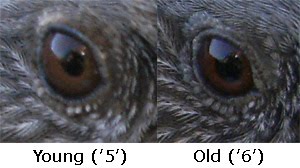
Dunnock, robin and great tit all found their way into the nets. Two dunnocks of different age were caught at the same time, allowing us to compare them in the hand. The eye colour was noticeably duller in the yearling, even though this is a more reliable character in the Autumn (see pics).


There was quite a difference in the greater coverts betwen the two, but according to the ringing bible (Lars Svensson's Little Green Book), this doesn't really tell you anything. Still, here is a picture of dunnocks with different looking greater coverts:

The GCs are clearly different between the birds, which probably tells you nothing about their age or sex (Little Green Book, pg. 104)

Before releasing the dunnocks, Rich briefly contemplated following the example of Paul the alien, but decided that this might bring displeasure from the Gods of Ringing. Looking back, he was probably right.